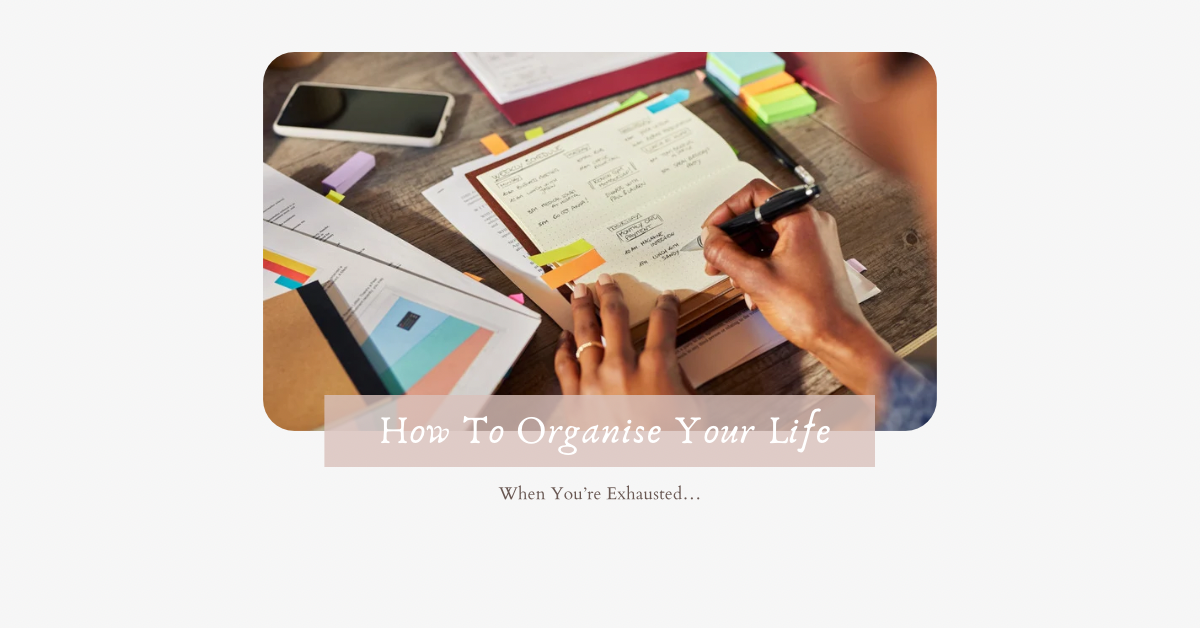
Organise life when exhausted? Is it possible?
If you’re reading this while running on cold coffee, interrupted sleep, and the mental load of everyone else’s needs — you’re not alone.
Most advice about organisation assumes you’re well-rested, motivated, and have spare time. But what if you’re exhausted? What if the idea of “getting organised” feels like another impossible task on an already overflowing to-do list?
This guide is for the tired mums. The ones who want a calmer, more organised life, but don’t have the energy for colour-coded systems, early mornings, or “just try harder” advice.
You can organise your life when you’re exhausted — it just needs to look very different.
Why Traditional Organisation Advice Doesn’t Work When You’re Tired
Most organisation systems fail exhausted mums for one simple reason: they require energy upfront.
- Deep decluttering sessions
- Perfect routines
- Weekly resets
- Daily planners filled in religiously
When you’re already depleted, these systems don’t feel supportive — they feel like another standard you’re failing to meet.
Exhaustion isn’t a personal flaw. It’s often the result of:
- Constant caregiving
- Interrupted sleep
- Mental load
- Hormonal changes
- Work + home + emotional labour
The goal isn’t to “push through” the exhaustion. The goal is to organise your life in a way that respects it.
Reframing Organisation: Less Control, More Support
When you’re exhausted, organisation isn’t about doing more — it’s about removing friction.
Instead of asking:
“How can I be more productive?”
Try asking:
“How can I make life easier for future me?”
This subtle shift changes everything.
Organising your life when exhausted means:
- Fewer decisions
- Lower expectations
- Systems that work even on bad days
- Progress that’s gentle, not dramatic
Step 1: Start With One Small Area That Affects Your Daily Stress
When energy is low, organising everything at once is a guaranteed failure.
Instead, choose one area that causes daily friction.
Examples:
- The kitchen bench where clutter piles up
- The pile of school papers
- Your handbag or nappy bag
- The notes app full of half-finished thoughts
Ask yourself:
“If this one thing was easier, would my day feel slightly lighter?”
That’s your starting point.
Low-Energy Rule:
You should be able to organise this area in 10–15 minutes max — or stop sooner if you need to.
Step 2: Use the “Good Enough” Decluttering Method
When you’re exhausted, perfection is the enemy.
Forget:
- Sorting into 12 categories
- Finding the perfect storage container
- Making it Instagram-worthy
Instead, use three simple piles:
- Keep
- Donate / Toss
- Not Sure
If you don’t know where something belongs, that’s okay. Put it in a temporary home.
Organisation that works when you’re exhausted is functional, not beautiful.
Step 3: Create Drop Zones Instead of Systems
Exhausted brains don’t follow complicated systems — they drop things.
So work with that reality.
Create intentional drop zones:
- A basket for incoming mail
- A tray for keys and wallet
- A box for kids’ random items
- A note on your phone for all thoughts
If everything lands in one predictable place, you’ve already reduced chaos.
You can always refine later — when you have energy.
Step 4: Reduce the Number of Decisions You Make Each Day
Decision fatigue is a major reason organisation feels impossible when you’re tired.
The more choices you have to make, the faster your energy drains.
Gentle ways to reduce decisions:
- Rotate the same 5–7 meals
- Wear a “uniform” (similar outfits)
- Keep the same morning routine every day
- Use repeating grocery lists
Organisation isn’t about control — it’s about conservation of energy.
Step 5: Organise Your Mind Before Your Home
When you’re exhausted, mental clutter often feels heavier than physical clutter.
If your brain feels full, start there.
Low-energy mental organisation ideas:
- Keep one running to-do list (not five)
- Write everything down — even if you don’t act on it
- Use brain dumps instead of structured planning
- Choose 1–3 priorities per day, not 10
You don’t need a perfect planner. You need somewhere for your thoughts to land.
Step 6: Let Go of “Daily” Expectations
Many organisation systems assume consistency:
- Daily tidy-ups
- Daily planning
- Daily resets
But exhaustion is unpredictable.
Instead, organise in cycles, not days.
Examples:
- Weekly food planning instead of daily decisions
- Monthly resets instead of nightly tidying
- Seasonal decluttering instead of constant maintenance
Your energy fluctuates. Your systems should too.
Step 7: Build Systems That Still Work on Your Worst Days
Here’s a powerful question:
“What would this look like if I only had 20% energy?”
That’s the system you need.
Examples:
- Laundry baskets instead of folding
- Pre-packed snack drawer for kids
- Digital reminders instead of memory
- Bulk cooking on good days for bad ones
If a system only works when you’re motivated, it’s not a good system.
Our routine tracker sets habits you can keep up even on those bad days…
Step 8: Use “Minimum Viable Organisation”
You don’t need an ideal routine — you need a minimum viable one.
Ask:
- What’s the bare minimum that keeps things functioning?
- What can I let slide without real consequences?
For many mums, this might be:
- Dishes washed once per day
- Laundry clean, not folded
- Meals simple, repetitive
- Floors “safe,” not spotless
Organisation that keeps you sane is successful — even if it doesn’t look impressive.
Step 9: Organise for the Season You’re In
Life has seasons:
- Newborn stage
- School chaos
- Illness
- Burnout
- Grief
- Busy work periods
Trying to organise your life as if you’re in a calm, rested season will always fail.
Instead, ask:
“What do I realistically have capacity for right now?”
Your systems should change as your season changes — and that’s not failure. That’s wisdom.
Step 10: Release the Guilt Around Rest
One of the biggest blocks to organising your life when exhausted is guilt.
Guilt for:
- Not doing enough
- Not keeping up
- Needing rest
- Wanting things to feel easier
But rest is not the opposite of organisation.
Rest is what makes organisation sustainable.
Sometimes the most organised choice is:
- Going to bed early
- Leaving the mess for tomorrow
- Saying no
- Choosing ease over effort
What Organisation Really Looks Like When You’re Exhausted
It looks like:
- Simplified routines
- Flexible systems
- Lowered expectations
- Kind self-talk
- Progress over perfection
It looks like choosing support over pressure.
Remember you don’t need to overhaul your life. You don’t need a fresh start. No you don’t need more discipline.
You need systems that meet you where you are.
Final Thoughts: You’re Not Failing — You’re Tired
If you’re trying to organise your life while exhausted, it means you care. It means you’re looking for a better way — not a harder one.
Start small.
Choose ease.
Build gently.
Rest when you need to.
Organisation isn’t about becoming someone else — it’s about making life work for the person you already are.
And that person deserves support, not shame.